Is Purus Xulture a Mix of Native and Eroupean Art Form Anchent Peruvian Pottery Was Verry Eficiant
Moche Ceramic Vessels

The Moche civilization began its history around 200 A.D. along Peru's northern declension and fell around 900 A.D. Compared to the cultures who came before and after, in both Central and Southward America, the Moche excelled in their craftwork through innovation and sophistication. Their artisans and artists left behind valuable looking-glasses to their civilisation's values, ideology, mythology, and religious practices institute in the crafts they created. As 21st century viewers, we must go on in mind that these objects were made with a Moche artisan's intention. It is crucial to understand these objects within the historical and cultural contexts they were meant to be viewed. The vast range of iconography plant in ceramic vessels and sculptures are essential for allowing fine art historians and other scholars to pull critical points from the culture. Nevertheless, they were also well known for silverwork and textiles every bit well.
Moche pottery and ceramics are unique for their naturalistic representations and overall technique in construction. The fine art represents a wide range of subjects, from humans, animals, mythic figures, and plants. Moche pottery'southward distinctive characteristics are the colors, artistic rendering, and arguably almost distinctive, the "stirrup" spout. The stirrup spout looks similar to modern fitness kettlebells with an attached tube at the pinnacle. Many of these ceramics were made from molds, which could rapidly produce many of the same blazon. While I could write pages about many kinds of stylization of Moche ceramics, some of the most captivating are the homo figures, peculiarly the head. Many scholars hail these depictions for their "portrait-like" representations of anatomical forms. Whether or not they represent a item person's physical likeness in history, we will never know. However, they evidence united states of america which elements a Moche person considered important plenty to represent. These representations tin speak a thousand words about the culture, from facial tattoos, textile patterning, piercings, and overall advent.
Pictured here nosotros see a portrait caput vessel from the MONAH drove. While less elaborately decorated than others, it shows depicts the likeness of an individual from the past, featuring their face paintings or facial tattoos. Other portrait vessels capture material patterning, jewelry, and fifty-fifty signs of scarring and illness. Information technology is interesting to consider their thought process on including these blemishes. The caput vessel is much different from other ceramic man representations of the aforementioned civilisation. Above, we take three different vessels from the drove: ii full seated figures, and ane smaller effigy sitting on a canteen with a painted scene. The iconography of each shows vastly different representations of the people. Y'all tin run into how this is a circuitous gild full of beautiful textiles, intricate garments, and maybe express freedom of artistic expression.
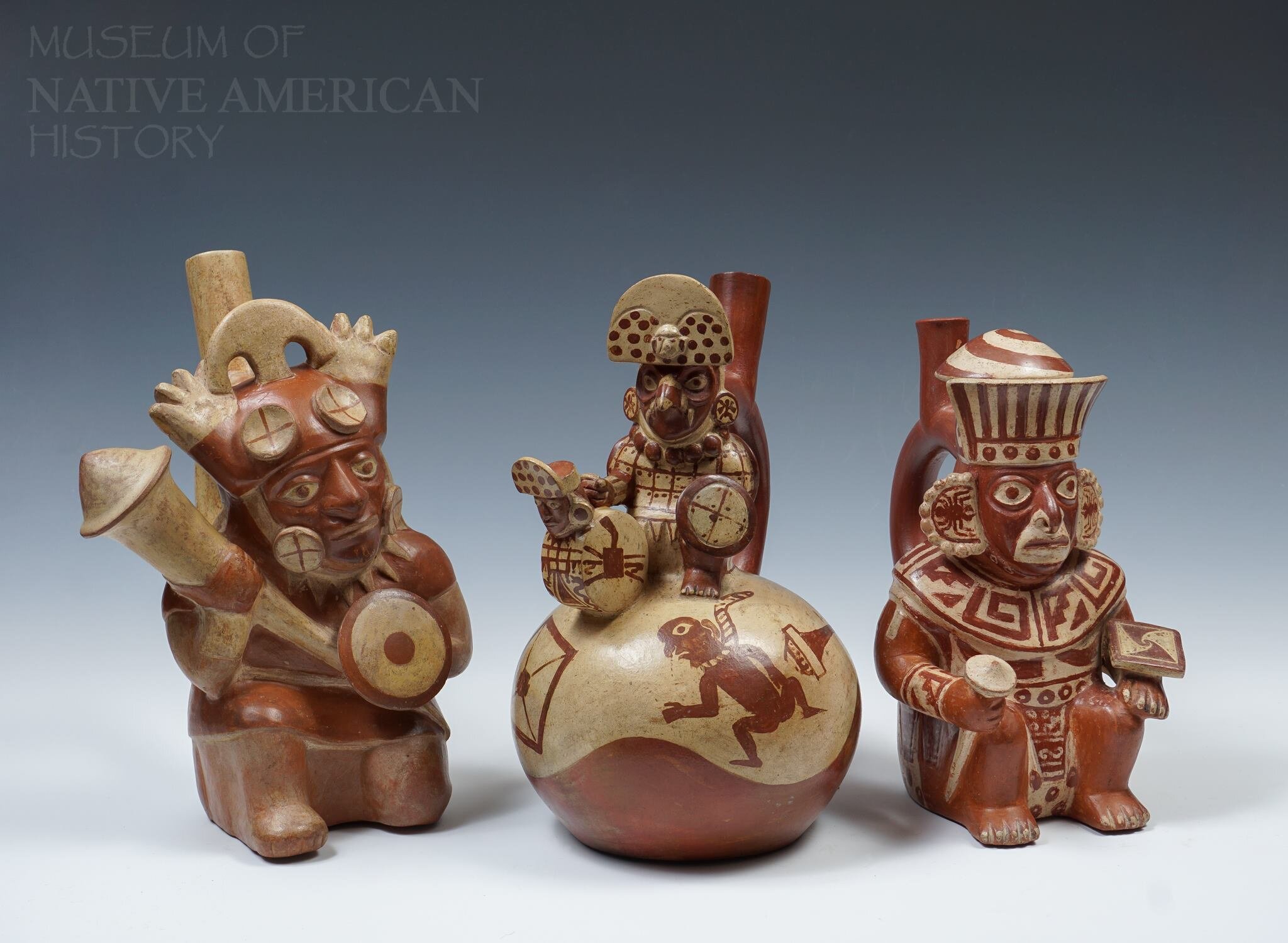
Moche Kneeling Warrior Figure Bottle, Period Four, Due north Coast of Republic of peru (A.D. 100 - A.D. 800)
Moche Owl-Warrior Stirrup Vessel, Period IV, North Declension of Republic of peru (A.D. 300 - A.D. 500)
Moche Warrior Effigy Bottle, Period Iv, N Declension of Republic of peru (A.D. 300 - A.D. 500)
So what about the ceramic craftsperson? While we do not know much about the crafts' conditions, archaeologists and other scholars continue to figure out this side of the story. For example, arts were a large part of the city at an archaeological site at Pampa Grande, a Northern Urban Capitol around 700 A.D. Some workshops discovered accept evidence of multiple crafts, which were probable a part of a collaboration and coordination betwixt unlike artisans. For example, artisans worked textiles and metal within the same complex to combine their work into i product, a garment with metal embellishment. Within a workshop, the artisans gave their loyalty and service to the elites, who managed the site, in exchange for food, drink, and hospitality.
Since we have no written record from the Moche, we rely on their art to speak for them. The contexts of the object would take imbued meaning to the intended viewer. Artisans and elites indeed were selective in their representations of society, focusing on what is necessary for the object'due south intended use. Ceramics would have been used domestically and ritually; they were besides important in ceremonial burials. As yous expect at these ceramics, you lot could imagine the importance of representing a religious official for a ceremony or perhaps a warrior at the grave of a fallen soldier. The portrait vessels, besides, for taking on the likeness of someone in decease. Moche art requires us to await across the object and towards the human context and meaning it iterates. The art of this culture lasts forever to tell their stories.
Weblog by Jazlyn Sanderson
References:
Shimada, Izumi. "Tardily Moche Urban Craft Product: A Commencement Approximation." Studies in the History of Art, 63 (2001): 176-205.
Trever, Lisa. "A Moche Riddle in Clay: Object Knowledge and Artwork in Ancient Peru." The Art Bulletin, 101:4 (2019): 18-38.
Source: https://www.monah.org/artifact-blog/2021/1/27/moche-ceramic-vessels
0 Response to "Is Purus Xulture a Mix of Native and Eroupean Art Form Anchent Peruvian Pottery Was Verry Eficiant"
Post a Comment